
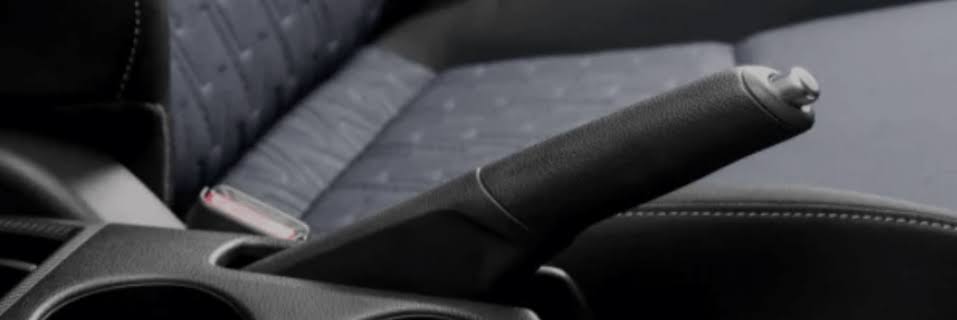
Your parking brake is a valuable component that helps ensure better safety when parked on an incline, and also helps reduce unnecessary loading of the transmission. If you’ve ever parked on a hill and not used the parking brake, you’re familiar with the loud “thunk” and lurch that happens when you crank the car and put it in drive when you’re ready to leave. Engaging the parking brake avoids this, and enhances safety. However, if your parking brake is stuck, the light in your dash will stay on, and you may damage the brake shoes while driving.
How this system works:
Your parking brake is actually very little more than a lever attached to a cable. When you pull the parking brake handle in the cabin, it engages a cable. That cable runs from the parking brake handle under the car and to the back wheels. Pulling up on the handle pulls the cable taut, which engages the parking brake. The brake itself is nothing more than a pair of small brake shoes mounted inside the drum built into the rear rotors of your car. The shoes press outward on the drum, holding the wheel in place (it’s not as strong as your normal brakes, and generally cannot hold the car by itself on anything more than a very gentle incline). When you put the parking brake handle down, the cable disengages the parking brake and the shoes retract from against the walls of the drum. This releases the vehicle, allowing you to drive without damaging the parking brake.
Common reasons for this to happen:
● Bad Switch: One common reason for the Parking Brake light to stay on is a failing or failed switch. This can be checked easily by jiggling the handle after it is down. If the light turns off (or turns off and then back on), the switch is the most likely culprit and will need to be replaced.
● Brake Handle Not Completely Lowered: Another reason for the light to stay on is if the brake handle is not completely lowered. Double-check that the handle is all the way down and that the parking brake is disengaged. Any pressure on the parking brake cable will cause the light to stay on.
● Parking Brake Not Disengaging: Sometimes the trouble isn’t with the switch or the cables, but with the parking brake itself. If the brake does not disengage when the handle is lowered, the warning light will stay on in the dash.
● Low Brake Fluid: Your Parking Brake light is a multifunction device, and is designed to illuminate if the fluid level in the reservoir drops below a certain point. You may notice the light turning on or off when going around turns as the fluid level changes.
● Bad Level Sensor: Your master cylinder is equipped with a brake fluid level sensor. It’s sometimes mounted in the side of the sensor, and is sometimes part of the reservoir cap. If the sensor fails or is going bad, the Parking Brake light will turn on.
● Uneven Fluid Pressure: If your car is experiencing uneven brake fluid pressure in one or more lines, it will affect braking performance, and could possibly cause the vehicle to pull to one side or the other during braking. It can also turn on the Parking Brake light in your dash.
What to expect:
A professional mobile mechanic will come to your home or office to investigate the problem. The mechanic will check the parking brake handle, switch, fluid reservoir and other components, and then provide a detailed inspection report that includes the scope and cost of the necessary repairs.
How it's done:
The mechanic will perform a full inspection on your parking brake system, including the handle, switch and the parking brake shoes. The mechanic will also inspect other brake system components, including the reservoir, cap, fluid level sensor and more. It may be necessary to pull brake system codes from the car’s computer as well.
How important is this service?
While your parking brake is not integral to safe driving, it’s an important component on your car. Moreover, a Parking Brake light that will not go out can indicate many different things, including the parking brake not disengaging, a failed parking brake switch, or even low fluid in the master cylinder reservoir. One of our professional mechanics can inspect the system and determine the underlying cause, ensuring that your car is working properly.


Leave a comment
Your email address will not be published. Required fields are marked *
You must be logged in to post a comment.